
Some trips are things you look at. Others change you. The difference has nothing to do with how beautiful a place is; it is about what it does to you: a shift in perspective, an unexpected encounter, a moment where your assumptions quietly dissolve. Georgia, Kyrgyzstan, Bolivia, Laos: these destinations do not always make the best Instagram spots, but they have a well-earned reputation for permanently changing the way you see the world.
What “changing your outlook” actually means
Travelling to change your perspective is not a stance reserved for seasoned explorers. It is the concrete result of a trip that exposes you to a reality very different from your own, with enough time and openness for something to genuinely shift.
The trend is well documented: according to a 2025 Travel Insight study, 73% of French travellers want their trip to leave a positive impact, and 52% acknowledge the effect tourism has on local communities. This is no longer the collect-the-stamps model of travel, ticking off as many sights as possible in a fortnight. It is about seeking genuine contact.
That genuine contact is rarely found on the most-visited routes. It is found where you are a guest, not a customer.
To understand this shift in our relationship with travel, read also Travel to understand, not just to see.
Four destinations that genuinely shift your perspective
These four countries are not exotic destinations in the marketing sense of the word. Nor are they reserved for hardened travellers. But they share something important: they place you in a situation where your usual frame of reference no longer quite works.
Georgia: the Caucasus between East and West
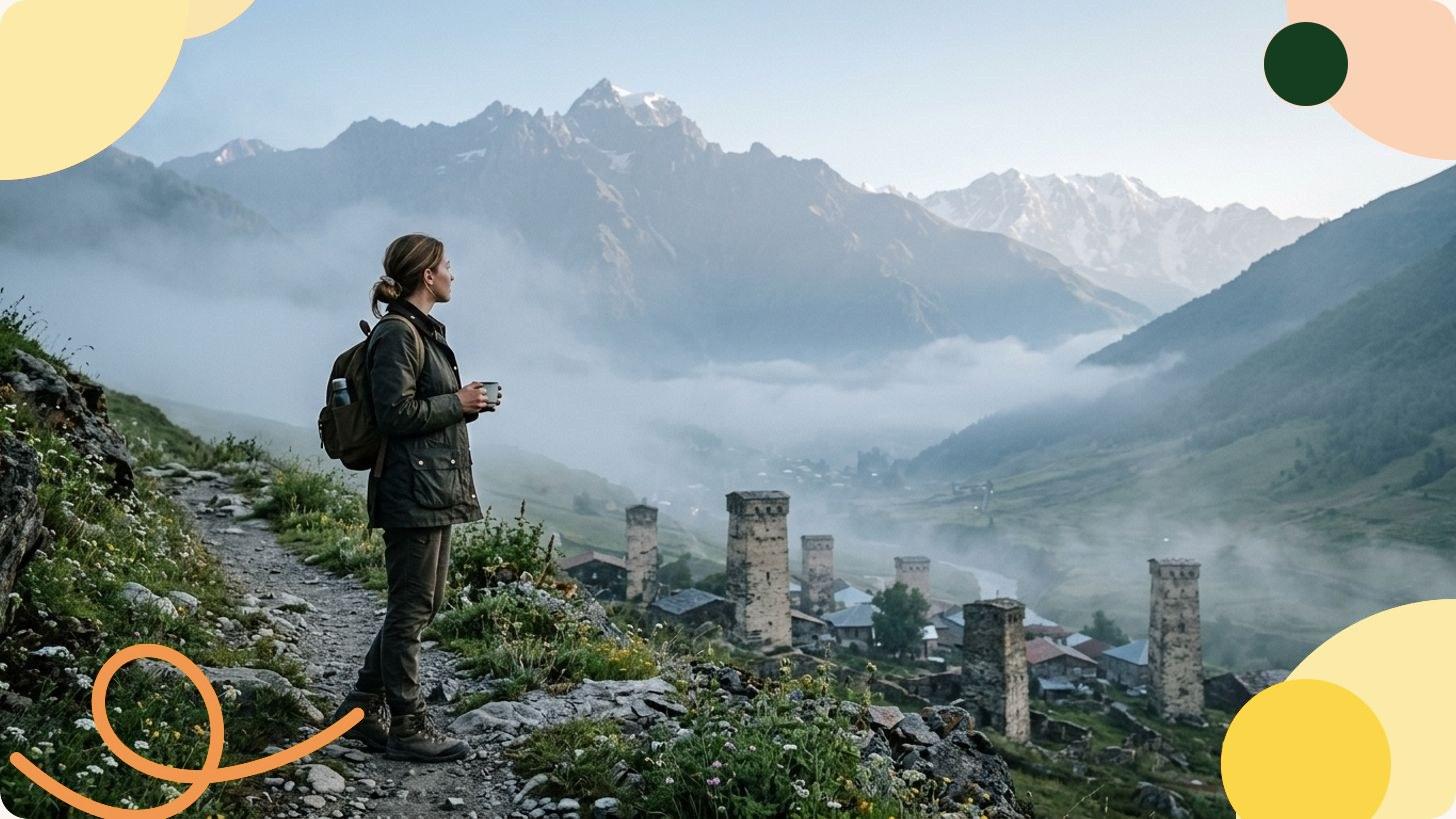
Georgia is one of those destinations that defies easy categories. It is not Asia, it is not Europe. It is a country with a millennia-old tradition of hospitality, the peaks of the Greater Caucasus, one of the world’s oldest winemaking cultures, and a complex history woven between East and West.
What transforms you here: you are immediately invited to the table. Connections with Georgians form quickly, without the usual tourist barrier. In the villages of Svaneti or Kakheti, you encounter a way of life that has no need of you to function. It is disarming, in the best possible sense.
Kyrgyzstan: living nomadism in the Tian Shan mountains
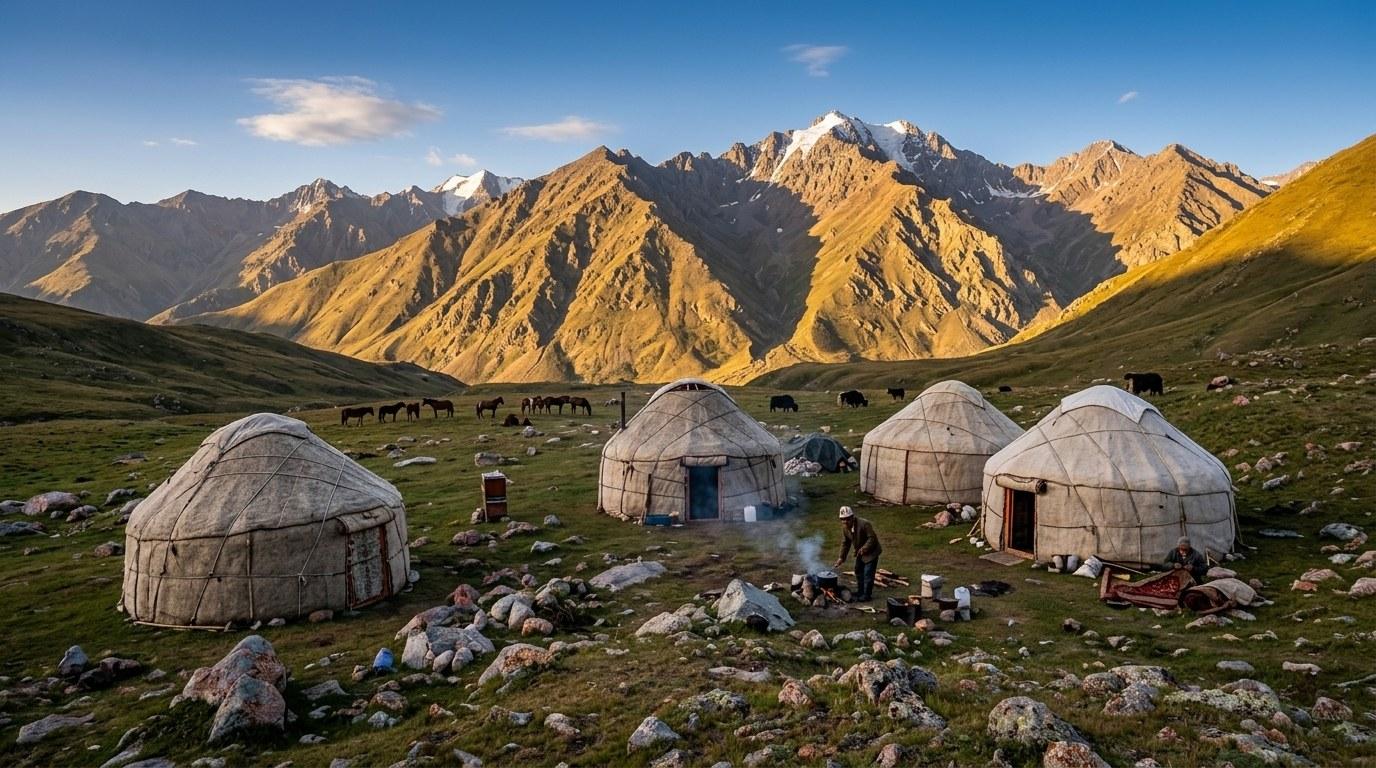
Kyrgyzstan preserves a nomadic way of life that is real, not staged for tourists. In summer, families of shepherds set up their yurts in the jailoos (high-altitude summer pastures) and live by the rhythm of their herds. Spending a few nights at one of these camps, sharing meals and silences, ranks among the most genuinely immersive experiences available to ordinary travellers.
The landscapes of the Tian Shan, with their turquoise lakes, snow-dusted passes and valleys beyond mobile signal, do the rest. Scrolling is not really an option.
Bolivia: where the landscape strips away certainty
The Salar de Uyuni, a vast and perfectly flat expanse of white salt, is one of those places where your sense of distance and perspective literally breaks down. But Bolivia shifts your outlook for other reasons too: it is one of the South American countries where indigenous cultures, Aymara and Quechua, remain a living part of daily life, present in markets, clothing and ritual. You are not in a museum.
Laos: the pace that changes everything
Laos is not spectacular in the conventional sense. Its towns are small, its roads sometimes slow, its temples understated. But it is precisely this rhythm, so radically different from your own, that works on you. In Luang Prabang, the early-morning alms-giving ceremony is not a performance: it is a daily practice you happen to be witnessing. That fine line between observation and intrusion forces you to reconsider your own position.
What stays with you: people, not places
Travellers who come back transformed rarely talk about a landscape. They talk about a conversation with a stranger, a meal shared without a common language, a moment when they had to let go of control and simply trust.
78% of French travellers want their spending to benefit local communities directly. Choosing a locally owned guesthouse over an international chain, eating where the locals eat, taking the shared bus: these are decisions that create the conditions for real encounters.
The unexpected plays its part too. A delayed bus forces you to wait in a village café. A blocked road sends you through a corner of the country you would never have found otherwise. These are not planning failures; they are the cracks through which a trip gets in. The condition for living them without panic: have solid cover for what really matters (health, repatriation), and let go of the rest.
Get my travel insurance quoteSlow travel: fewer places, greater depth
The slow travel approach, staying longer in fewer places, is not a passing fashion. It is the logical condition for a trip that actually changes something. A week in a country gives you the scenery. Two or three weeks give you the beginning of understanding.
According to 2025 data, 84% of travellers are now gravitating towards secondary destinations, drawn by lower prices and fewer crowds. These destinations are often the most transformative: less tourism means more contact with local reality.
The idea is not to avoid the postcard at all costs, but not to stop there either. Passing through Tbilisi to reach the Georgian mountain villages, or through La Paz to get up onto the Bolivian altiplano: you combine accessibility with genuine immersion.
This shift in how we travel is also bound up with the decline of mass tourism, a phenomenon explored in Travel insurance: why the end of mass tourism changes everything.
Planning a trip that actually changes something
Kyrgyzstan, Bolivia, Laos, Georgia: all accessible countries, but not all equally equipped to handle a medical emergency. An accident at altitude in Kyrgyzstan, food poisoning in Bolivia, a health issue 150 km from the nearest large city in Laos: in these situations, you want to be able to call someone and have everything taken care of.
That is the role of travel health and repatriation insurance: not to stop you taking reasonable risks, but to let you take them without things turning into a financial disaster. Yupwego covers your medical costs and repatriation, whatever the destination, with a policy you can take out online in minutes before you leave.
Why travelling with peace of mind comes down to this kind of preparation is also explored in Why travelling today is built on safety, human connection and responsibility.
FAQ
Can these destinations be visited without a local guide?
That depends on your level of independence and the destination. Georgia and Laos are easy to explore solo using local transport. Kyrgyzstan in summer lends itself well to independent travel, with yurt stays easily arranged on the spot through local families. Bolivia calls for a little more care (altitude, remote roads) but remains very accessible without a permanent guide. In all cases, travel insurance covering medical care in remote areas is essential.
Do you need to speak the local language?
No, but a few words make all the difference. In Georgia and Kyrgyzstan, English is limited outside the main cities; that is precisely what pushes you to find other ways to connect. In Laos, French is still spoken by some older generations. In Bolivia, Spanish opens up virtually the entire country to you.
What budget should you allow for this kind of trip?
Georgia, Kyrgyzstan, Laos and Bolivia are among the most affordable destinations in their respective regions. The international flight is usually the single biggest cost. On the ground, expect to spend considerably less than you would in Western Europe on both accommodation and food.
How do you choose a destination if you genuinely want to change your outlook?
Look for somewhere your usual frame of reference breaks down: the language, social codes, relationship to time, to food, to public space. That disorientation is the engine of transformative travel. If you are new to this kind of exploration, the top destinations favoured by seasoned travellers is also worth a look for more familiar starting points.
Is travel insurance really necessary in these countries?
Yes, more so than in conventional tourist destinations. Medical infrastructure in countries like Kyrgyzstan or Bolivia can be limited away from the capitals, and a medical repatriation without cover can run to tens of thousands of pounds. Insurance is what lets you set off with confidence for destinations well off the beaten track.