
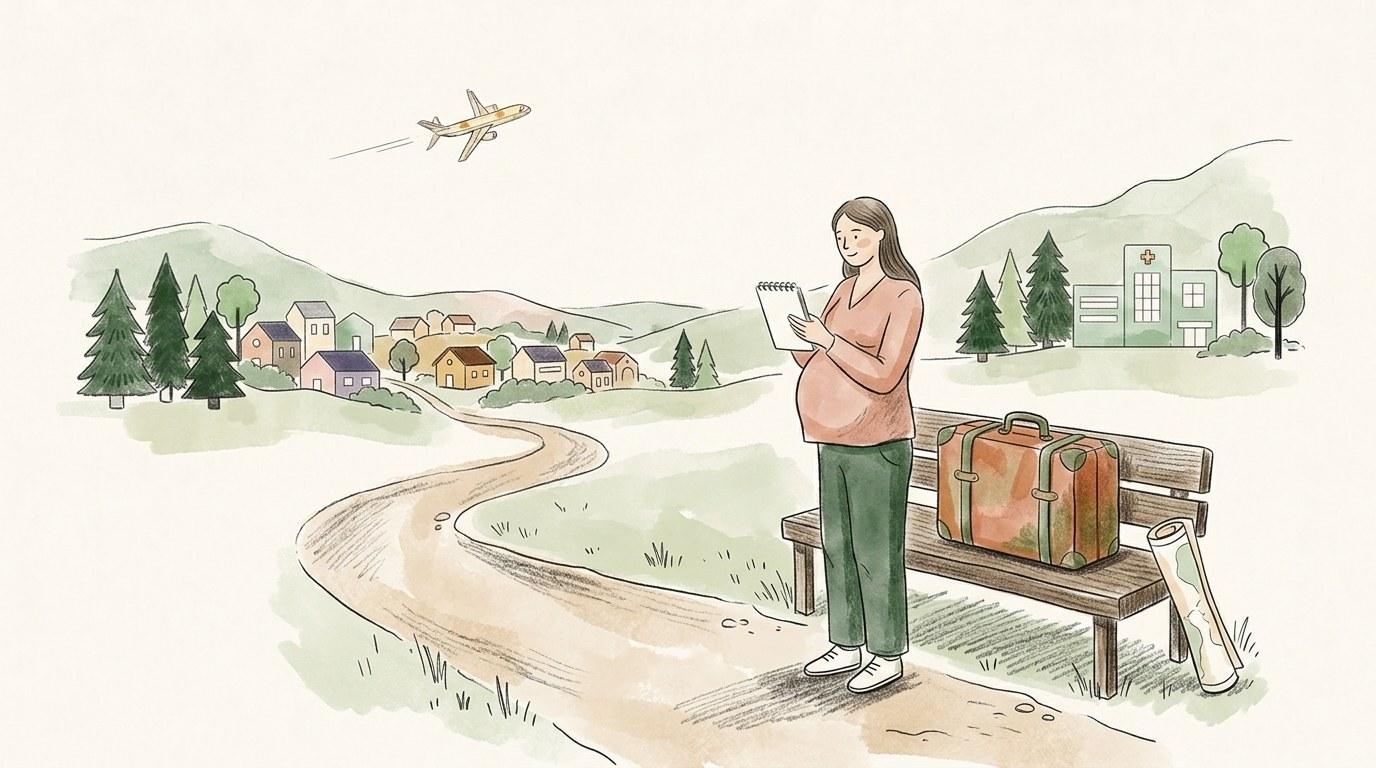

Yes, taking out travel insurance while pregnant is entirely possible. The vast majority of insurers accept pregnant travellers, but with specific conditions: cover for complications typically ends between 28 and 32 weeks of pregnancy, routine antenatal care remains excluded, and any previously diagnosed high-risk pregnancy may be treated as a pre-existing condition. Here is what you need to know before you travel.
What travel insurance actually covers during pregnancy
Travel insurance is not designed to replace your routine antenatal care. Its purpose is to cover the unexpected: a sudden complication far from your usual healthcare network, where medical bills can quickly run into tens of thousands of pounds.
Guarantees typically included (depending on your policy):
- Emergency medical expenses: consultations and hospital stays linked to an unexpected obstetric complication (bleeding, gestational hypertension, threatened premature labour, deep vein thrombosis…)
- Medical repatriation: transfer to your home country or a specialist facility, with medical accompaniment
- Trip cancellation or curtailment: if your obstetrician or midwife certifies in writing that your health makes travel impossible or the trip must be cut short
- Direct payment of bills: the best policies settle hospital fees directly, so you are never left advancing thousands of pounds abroad
To understand the difference between what travel insurance covers and what your regular health insurance provides, read the differences between travel insurance and health insurance.
Get my quote onlineCoverage limits you absolutely need to know
The gestational age limit: the first thing to check
This is the most important criterion. Most policies set a coverage cut-off around 28 to 32 weeks of pregnancy; some more restrictive policies stop as early as 24 weeks. Beyond these limits, insurers consider the risk of delivery too high.
In practice: if you are planning a trip at 26 weeks, check that your policy explicitly covers up to at least 28 weeks, and read the wording in the general conditions carefully.
Airline rules: separate from your insurance
Even with insurance in place, you still need to be allowed to board. Most airlines set their own cut-off limits:
- Up to 36 weeks for short-haul flights, often with a recent medical certificate required
- Up to 32 weeks for long-haul flights
These thresholds vary by airline and can change. Check directly with your carrier before booking; insurance does not compensate for a foreseeable refusal to board.
High-risk pregnancy and pre-existing conditions
If your pregnancy is classified as high-risk before you take out the policy (threatened miscarriage, Rhesus incompatibility, complicated twin pregnancy, pre-existing gestational hypertension…), insurers may apply a pre-existing condition clause. The general rule: any complication already diagnosed before signing the policy will not be covered.
What is not covered: standard exclusions
- Routine antenatal care: check-up scans, standard appointments, blood tests, non-emergency prescriptions
- A planned full-term delivery abroad
- Postnatal and neonatal care (except for an unexpected emergency, depending on the policy)
- Complications from a high-risk pregnancy known before the policy was taken out
- Pregnancy itself as a cancellation reason: being pregnant alone does not entitle you to a refund. A certificate from your obstetrician or midwife confirming you are unfit to travel is required to trigger the cancellation guarantee
- Contraindicated activities: extreme sports, high altitude and destinations with a high health risk may invalidate certain guarantees
How to choose the right travel insurance when pregnant
Five non-negotiable points to compare
- The gestational age limit: make sure it matches your stage of pregnancy at the time of travel
- Obstetric complications explicitly covered: threatened premature labour, pre-eclampsia, complicated miscarriage…
- The overseas medical expenses ceiling: depending on the policy, this ranges from €150,000 to over €1,000,000
- 24/7 assistance in your language: essential for communicating with a local hospital and organising repatriation
- Direct payment of bills: avoids tying up large sums and needing to pay out of pocket if hospitalised
Declare your pregnancy when taking out the policy
Failing to declare a known health condition before signing can constitute a material misrepresentation and lead to the policy being voided if a claim arises. Declare the pregnancy, ask the insurer to confirm in writing what is covered, and keep that document with your travel papers.
Take out cover as soon as you book
If your policy includes a cancellation guarantee, taking it out at the time of booking protects you from day one. A medical complication arising before departure will allow you to be reimbursed for flights and accommodation, subject to a medical certificate.
Get a medical certificate before you travel
Your doctor or midwife should confirm that travel is medically authorised on your planned departure date. This document may be requested by the insurer in the event of a claim, by the airline at check-in, and sometimes by the authorities at your destination.
For families travelling with a partner or children, additional cover can be invaluable: find out how to protect the whole family while travelling.
When to travel during pregnancy: useful benchmarks
Insurance steps in when the unexpected happens, but it is your doctor who decides whether a trip is right for your situation. A few widely accepted benchmarks:
The second trimester (weeks 14 to 28) is generally considered the most favourable window: first-trimester nausea has usually passed, the risk of premature labour remains low, and you are still within the coverage window of most policies.
Avoid without specific medical advice: destinations with intense heat or high health risks (malaria, dengue fever…), areas above 2,500 metres altitude, and regions without ready access to obstetric care.
If you are planning a more ambitious trip, the insurance implications are even greater: being far from your usual healthcare network is one of those things people often overlook about travel insurance until the moment they actually need it.
FAQ
Can you take out travel insurance after becoming pregnant?
Yes. An ongoing pregnancy is not grounds for refusal in the vast majority of policies, as long as you are within the gestational age limit set by the insurer. That said, take out cover as early as possible: some policies have a waiting period of a few days before guarantees come into force.
Is premature delivery abroad covered?
It depends on the policy. A threatened premature labour arising unexpectedly is generally covered. Premature delivery resulting from a high-risk pregnancy known before the policy was taken out is often excluded as a pre-existing condition. Read the general conditions carefully or ask for written confirmation from the insurer before you travel.
Is the European Health Insurance Card (EHIC) enough?
The EHIC covers treatment within the European Union, but with partial reimbursements capped at local rates and no provision for repatriation. Outside the EU, it has no effect. Comprehensive travel insurance picks up where public health cover stops, and additionally covers medical transport back home.
Do I need to declare my pregnancy when taking out a policy?
Yes, in the vast majority of policies. Failing to declare a known health condition can constitute a material misrepresentation and lead to the policy being voided in the event of a claim. Declare the pregnancy, ask for written confirmation of the applicable cover and keep it with your travel documents.
Can my partner and I take out a joint policy?
Yes, couple or family plans generally cover both travellers. Check that the main policyholder’s pregnancy is specifically mentioned in the policy conditions and that the gestational age limit suits your situation at the time of travel.