
Are influencers travel’s worst enemy? The honest answer: no, not on their own. But their role in accelerating overtourism is real and well-documented. What is at stake is the way we collectively choose, share and experience our trips, and the genuine possibility of doing better.
When a single video changes a place for ever
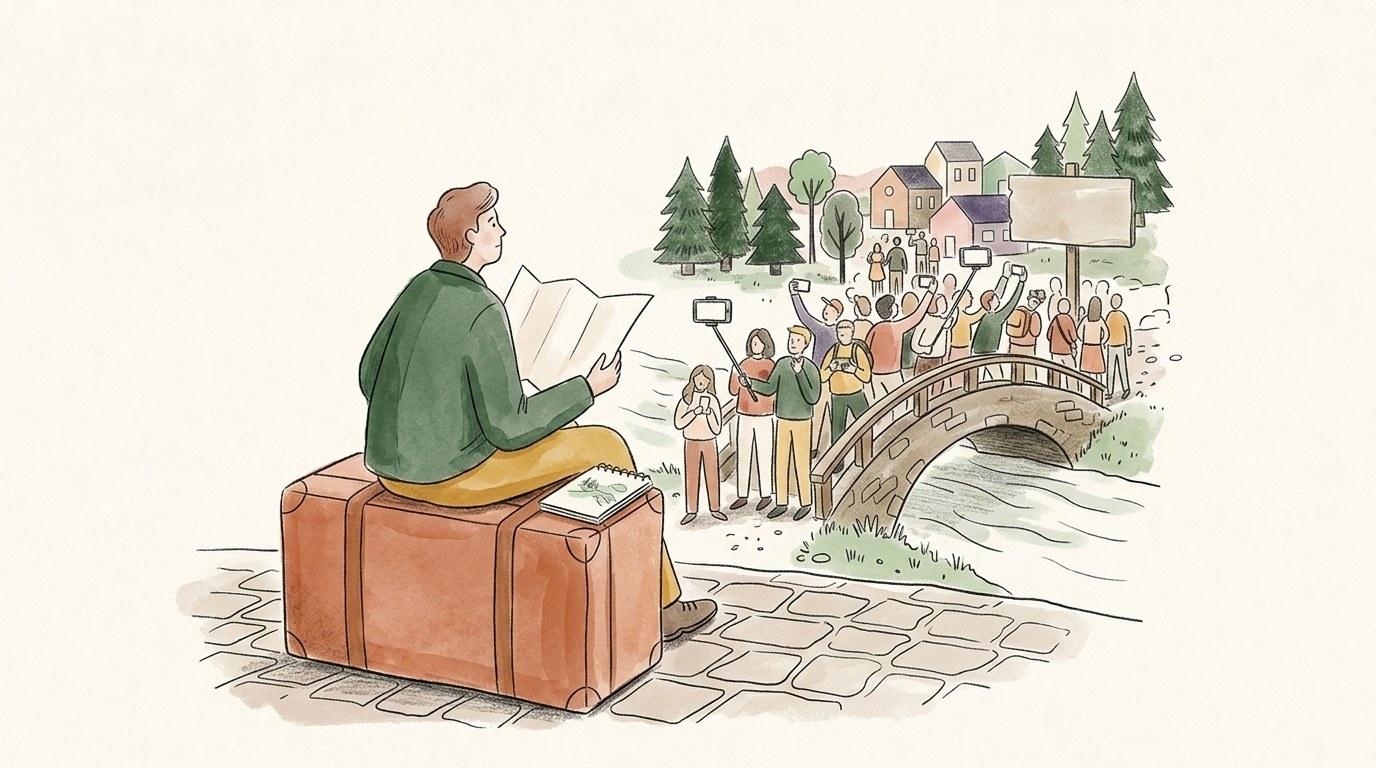
The pattern has become familiar, yet its effects remain striking. A viral video of a sunrise in a national park in Hainan, China, credited with 65,000 likes, was enough to push daily visitor numbers from 50 to 600. On Santorini, an island with a year-round population of just 20,000, thousands of tourists now arrive every single day during peak season, turning the village of Oia into one giant, gridlocked selfie queue.
In Bali, the crowds snaking in front of Lempuyang Temple and through the rice terraces of Jatiluwih have transformed spaces of quiet contemplation into open-air photo studios. The same story plays out in Iceland, along the Amalfi Coast and in various Japanese villages, where “no photography” signs have become as common as trail markers.
This is not just anecdote: travel content on TikTok has surged by 410% since 2021, and 84% of travellers say they consulted an influencer’s profile before choosing their destination. The algorithm amplifies, the crowds follow.
The real cost of “Instagrammable” spots
Concentrating visitors around a handful of heavily promoted locations produces a perverse mass effect: thousands of people converge on the same fifty square metres, at the same golden hour, to recreate the same image. Residents endure saturated transport, rising rents and constant noise. Ecosystems absorb a level of footfall they were simply never designed to handle.
Regulatory responses speak to how serious things have become: Venice introduced a daily entry fee for day-trippers in 2024. The Balearic Islands, that same year, suspended promotional influencer campaigns and imposed a moratorium on hotel construction. Measures like these do not emerge without good reason.
Plan my trip with confidenceInfluencers are not the only ones responsible
Singling out content creators alone would be too easy, and inaccurate. 75% of travellers choose their destination based on what they see on social media, and nearly half admit they travel specifically to photograph a place and share it online. Supply is responding to massive demand, sustained by platforms whose algorithms reward the spectacular.
Travellers themselves are part of the dynamic: many set out to recreate exactly the photo they spotted online, at the same location, at the same golden hour. The destination becomes a backdrop for the image, not the other way around.
Platforms: invisible but structurally powerful
TikTok, Instagram, YouTube: these platforms monetise clicks and engagement. Content that reveals a “secret” spot explodes, gets replicated and racks up millions of impressions. Their algorithms have no incentive to promote destination diversity or off-season travel. This editorial bias is just as responsible for overtourism as the behaviour of individual creators, yet it is discussed far less often.
A new generation of creators changing course
Not everything in the world of travel influence deserves to be written off. A growing number of creators are now taking stock of their responsibility and making concrete changes to the way they work.
In France, the national plan to tackle overtourism, published in June 2023, brought in volunteer content creators with the explicit aim of discouraging mass footfall towards already saturated sites and promoting a different vision of travel. Figures such as Benjamin Martinie, known online as Tolt, have stopped flying altogether: they now explore France and Europe exclusively by train, swapping airline partnerships for stories of slow travel and alternative itineraries.
This is the de-influencing movement: creators publishing about why you should not visit an overcrowded destination and recommending lesser-known alternatives instead. A quiet but genuine shift in the sector’s norms, and proof that influence can also point towards less, and better.
If you want to explore this further, the page on slow travel as a form of responsible tourism looks in practical terms at how to organise a lower-speed, lower-impact trip.
What travellers can actually do
Most of the real leverage sits with us. Here are specific actions, not generalities.
Before you go
- Research low-season periods: some sites receive ten times more visitors in July than in November.
- Identify lesser-known alternatives to your main destination. Regional tourism boards often publish off-the-beaten-track itineraries that influencers have yet to discover.
- Choose lower-carbon modes of transport where the distance allows: train, long-distance coach, carpooling.
While you are there
- Visit popular sites early in the morning or late in the afternoon, outside the busiest windows.
- Follow local rules to the letter: stay on marked trails, do not feed wildlife, do not enter areas signed as off-limits.
- Choose local over international chains for food, accommodation and independent guides. It is often the most memorable experience, and the one that benefits host communities most directly.
- Ask before photographing people or ceremonies. That simple habit is also a mark of genuine respect.
In your relationship with social media
- Avoid pinpointing the precise location of fragile or little-known places. A beautiful photo shared without GPS coordinates protects what deserves protecting.
- Follow accounts that celebrate destination diversity and off-season travel: there are more of them every year, and they are often far more inspiring.
No trip is ever impact-free, and the aim here is not to pile on the guilt. But every choice that leans towards greater care and respect for local communities has a real effect: on visitor numbers at key sites, on community revenues, and on the long-term survival of the places we love most.
Responsible travel means being well prepared
A responsible trip starts with solid preparation: choosing the right time to go, planning a route that avoids peak crowds, and arranging appropriate cover in case something goes wrong. Travelling with peace of mind also means knowing you are protected if things do not go to plan: medical expenses abroad, emergency repatriation, round-the-clock assistance.
Yupwego donates 1% of its revenue to environmental organisations through 1% for the Planet, linking your travel protection to a concrete commitment to the planet.
For more on planning a calm, responsible trip, find out why responsible travel insurance makes all the difference before your next departure.
FAQ
Are influencers really responsible for overtourism?
In part, yes. Travel content produced by influencers has a major influence on destination choices: 84% of travellers say they consulted an influencer’s profile before deciding where to go. But they are not the only ones at fault: platforms that amplify spectacular content, travellers who want to recreate the same photos, and the absence of any regulation of tourist flows all contribute to the problem.
What is “de-influencing” in travel?
De-influencing refers to the practice of content creators publishing about why you should not visit an overcrowded destination, recommending lesser-known alternatives instead. It is an emerging trend aimed at easing pressure on the most saturated destinations and redirecting tourist flows towards sites that receive far less media attention.
How do you travel differently from the influencer trail?
Shifting your dates to off-season, exploring less publicised areas, visiting popular sites during quieter hours, spending locally, and avoiding geotagging fragile places on social media: these concrete habits reduce pressure on destinations and often make for a richer, more authentic travel experience.
Can destinations protect themselves from viral tourism?
Some already are. Venice introduced a daily entry fee for day-trippers in 2024. The Balearic Islands suspended promotional influencer campaigns and imposed a moratorium on hotel construction. In France, the national plan to tackle overtourism (June 2023) includes working groups with volunteer content creators to shift the narrative around travel.
Can influencers have a positive impact on tourism?
Yes. Creators like Benjamin Martinie (Tolt) show that it is possible to travel by train across Europe, champion destinations off the beaten track, and promote a slower, more locally rooted way of travelling. Influence can absolutely steer tourism in a more respectful direction, as long as creators and platforms make different editorial choices.