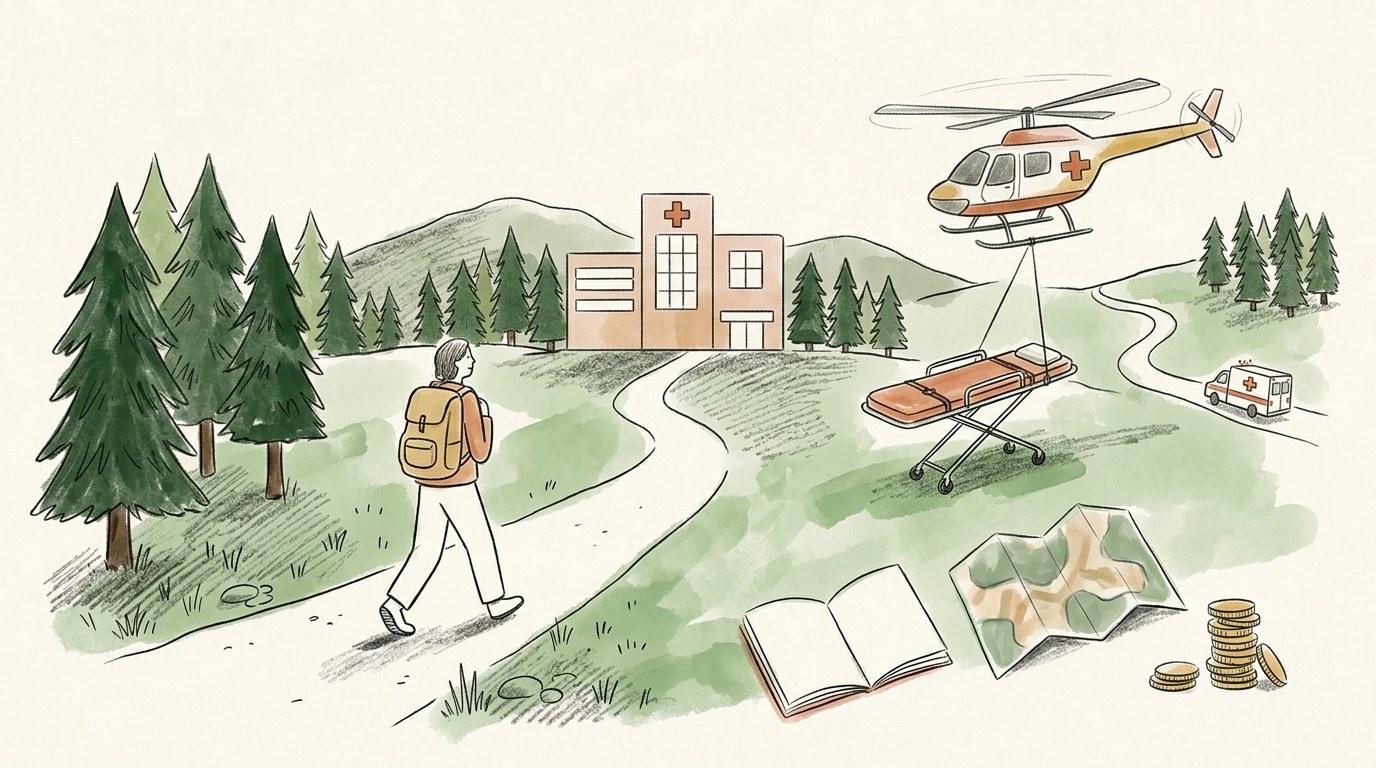

A medical emergency abroad can generate bills running into tens of thousands of euros, once you factor in treatment, repatriation and all the logistical fallout. These figures come as a shock because almost no one mentions them before you leave: not in the holiday brochures, not on the flight comparison sites. Here are the real numbers, destination by destination, and what they actually mean.
What medical care really costs, depending on where you are
Healthcare prices vary enormously from one country to the next. The same diagnosis can produce a bill ten times higher depending on where you happen to be.
United States: eye-watering emergency room prices
The United States is the most financially dangerous country for an uninsured traveller. A straightforward emergency room visit costs between €460 and €2,760. An appendectomy can easily exceed €45,000, sometimes €60,000. The hospital will often demand payment before the patient is even discharged.
Thailand and South-East Asia: the “cheap country” illusion
Thailand draws millions of visitors every year. Scooter accidents are common, and private hospital care, despite its well-earned reputation for quality, is priced close to Western standards. A hospital stay following a fall can cost between €4,500 and €13,700. A leg fracture requiring surgery can reach €10,000 to €30,000.
Australia, Canada, Switzerland: five- and six-figure bills
In Australia, a serious infection requiring a prolonged hospital stay can exceed €61,000. In Canada, pneumonia treated over several days in hospital regularly tops €20,000. In Switzerland, three days in hospital for a bone fracture can reach €15,000. These are reassuring, familiar-feeling destinations, which makes the financial shock all the more brutal.
Protect my trip with YupwegoMedical repatriation: the cost line everyone forgets
On-the-ground medical bills are only part of the total. If your condition requires a medically assisted return home, the costs soar:
- A medical air ambulance repatriation costs between €10,000 and €50,000 depending on the distance and the on-board equipment required.
- For long-haul destinations (Asia-Pacific, the Americas), this figure can exceed €80,000.
- French state health insurance does not cover medical repatriation outside the European Economic Area.
A medical repatriation is not a standard transfer. It is a complex medical and logistical operation: an on-board medical team, a specially configured aircraft, administrative clearances across multiple countries. The price reflects that reality.
What your existing cover actually does not pay for
Many travellers set off believing they are covered. The reality is more complicated, and it is worth checking before you leave:
- French state health insurance (Sécurité sociale) covers part of the cost of care within the European Union via the European Health Insurance Card (EHIC). Outside the EU/EEA, the cover is almost non-existent.
- Premium bank cards (Visa Premier, Mastercard Gold) include travel guarantees, but the limits vary significantly between banks and contracts. They rarely cover a long-haul repatriation or a serious hospital admission.
- Complementary health insurance (mutuelle) reimburses on the basis of French tariff schedules, which bear little relation to prices charged abroad, particularly outside Europe.
To understand exactly what different types of cover actually include, our guide on travel insurance: everything nobody tells you before you leave sets the record straight.
The invisible costs: mental, logistical and administrative
Beyond the numbers, a medical emergency abroad demands enormous energy that few people think about beforehand.
The mental load. Navigating a foreign healthcare system, often in another language, while injured or ill is exhausting. Finding the right facility, understanding the forms, making important decisions without your usual support network: the stress builds quickly.
The logistical fallout. A longer stay means extra hotel nights, flights to rebook with all their associated fees, and prepaid reservations that cannot be recovered. These unplanned expenses can add several hundred euros to the bill.
The administrative burden. Even with solid cover, travellers often have to pay upfront, keep every receipt, contact their insurer from abroad, and arrange for medical documents to be translated. Without support, this paperwork becomes a real burden at the worst possible moment.
A travel insurance policy with a 24/7 assistance line changes this experience fundamentally: one point of contact handles coordination with the hospital, organises the repatriation and keeps your family informed.
Why nobody talks about this before you leave
Several factors explain this silence.
The commercial logic of the travel industry. Travel agencies, flight comparison sites and travel accounts on social media all sell a dream. Mentioning hospital emergency rooms is bad for business. This bias in communication leaves travellers unaware of the real risks.
Optimism bias. We naturally assume that accidents happen to other people. Cognitive psychology research documents this well: we consistently underestimate personal risk. The result is that preparation gets put off and insurance feels unnecessary.
The invisibility of good outcomes. When a traveller with cover returns home after an incident that was handled smoothly, they rarely talk about it. The catastrophic uninsured experiences tend to stay hidden too, because they are as embarrassing as they are frightening.
For a closer look at what good cover actually changes when something goes wrong, read our analysis of the illusion that everything is simple when you travel.
Preparing before you leave: a step in its own right
Travel insurance does not replace solid preparation; it is an essential part of it. Check the health recommendations for your destination, the entry requirements and any specific risks. Our guide on how to plan your trip abroad properly walks through every step, from taking out insurance to entry formalities.
FAQ
How much does a hospital stay abroad cost on average?
The average cost of a hospital admission abroad exceeds €25,000 in 2025, according to international health specialists. The figure varies widely depending on the destination: from a few thousand euros for a minor incident in Asia to over €60,000 in the United States or Australia for a serious condition.
Does French state health insurance cover medical care abroad?
Within the European Union and the European Economic Area, the European Health Insurance Card (EHIC) allows partial reimbursement at each country’s local rates. Outside the EU/EEA, cover is very limited. In all cases, it does not cover medical repatriation.
How much does a medical air ambulance repatriation cost?
A medical air ambulance repatriation costs between €10,000 and €50,000 depending on the distance, the patient’s condition and the equipment required. For long-haul destinations, the figure can exceed €80,000. Without insurance, the traveller or their family bears the full cost.
Is my bank card enough as travel insurance?
Premium bank cards include travel guarantees, but the terms and limits vary between banks. These guarantees are often insufficient to cover a serious hospital admission or a long-haul repatriation. Read the terms and conditions of your card carefully before relying on it alone.
What does travel insurance actually cover?
Depending on the policy, travel insurance can cover medical and surgical costs, hospital admission, medical repatriation, extended-stay expenses and 24/7 assistance. Guarantees, limits and exclusions vary between policies and insurers: always read the terms and conditions carefully.